
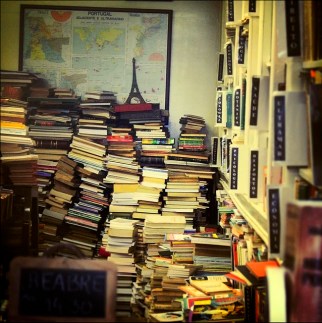
 Let’s talk about the future of books by stating the obvious: books take a long time to write.
In fact, per hour, I think they’re definitely one of the top most time-consuming forms of art.
Writing a book in a year is considered almost a heroic effort.
Two, three years, well, that’s about normal.
A lot of books are late-bloomers, too, and won’t get finished for years and years.
Authors are willing to put in the sweat, blood, and missed Life Opportunities to write.
When it’s done, we put every sentence to a magnifying glass, carefully scan the pages… then promptly decide we hate it, ALL OF IT.
We write and rewrite, which adds more time to the process.
But is that the way writers should be writing in the 21st century?
Our exponential rate of consumption
Everyone knows machines get faster every year. Their processing speeds more or less grow exponentially.
That means our capacity to consume information grows exponentially every year, too.
That prompts us to consume more things, faster.
Just think about the way you’re reading this blog post.
Even if you’re interested in it, your eyes are more than likely skittering around, looking hungrily at the other links.
Maybe you’re tapping a finger on your mouse, ready at a moment’s notice to flee to Facebook at the first sign of Boredom.
Creating a 20th-century product in a 21st-cenutry world
As we redefine what a “book” really is, we need to consider how people are consuming information.
Really, people are reading more than ever.
Just to be socially acceptable in high school and most other phases of life (which, let’s admit it, are just mutated versions of high school), you need to have some kind of online Thing, be it Facebook or Twitter or Tumblr.
Teenagers sent an average of 60 texts a day in 2011. Most teen girls send 100 or more a day.
Americans are reading. They’re just not reading what we as writers wish they would read.
Reading has already been redefined.
What does it mean to read today?
It means you have the internet. So, everyone is a reader now.
With the advent of mobile devices, our rate of information consumption will continue to grow.
Worse, we take it for granted that content – such as this insightful blog post – should be free. In fact, we more or less demand that it should be free.
We even laugh at authors who try desperately to get paid “the old way” for their writing.
So “writing” really has to be a labor of love at this point.
Especially when you spend three years writing a novel, five years shopping it around to agents, and then decide to give it away for free on Kindle Direct Publishing.
It’s time to redefine the novel
Don’t panic. Look at this beautiful picture of Arthur’s Seat in Edinburgh, Scotland:

Books are going to be okay.
Our notion of what a book is… well, that probably won’t be.
Anyone past the age of ten today who considers themselves an “author” is an unwaveringly proud member of a dying breed.
It’s very likely writers younger than that won’t even know what “paper” is.
By default, we’re part of an endangered species of writer who clings to ivory tower conceptions of what makes a book a book.
Admit it to yourself.
Even with the undeniable rise of ebooks, you’re still writing with the hopes of one day being validated by a group of people in New York City.
Here’s what’s going to happen:
- Books are going to get shorter [happening]
- New ways to monetize books like pay-for-chapter and subscription e-delivery service will develop [happening]
- Short stories will go through a renaissance as a potential marketing tool for novels [happening]
- Magazines & e-zines that offer visibility will be more important than cash prizes [happening]
- Magazines & e-zines will start publishing ebook excerpts to highlight new works by up-and-comers [happening]
- Publishers will acknowledge ebooks and come up with innovative ways to help authors [happening]
- Writers are going to have to get used to all of this
Did you notice that all of these predictions are already coming true except for that last one?
If you’re a writer, you’re going to have to get comfortable with this change. Things aren’t going back to what you think of as “normal.”
You’re going to have to stop turning your nose at ebooks that seem like they’re poorer quality than your own book. Ebooks you think are “flooding” the market.
You should cheer your fellow authors, because they’re paving the way.
If you already have a published ebook, you need to stop thinking it’s not a “real” book. Because it is.
When authors start writing shorter books, people will consume more books.
When publishers begin to innovate, as they’re slowly starting to do, then people will consume more books.
Take a deep breath.
None of this is bad, it’s just different.
This is all going to mean that your books are going to get published faster so you have more time to write more.
Isn’t that the dream?
The breakdown
1. Don’t panic about the future of books. Adapt.
2. Short stories can be a serious potential tool in growing readership for your book. Write them. They’re fun.
3. Change is going to be violent and unpredictable for authors as traditional publishing houses and newcomers like Amazon & Apple clash.
4. Think about where your book will be published, how it will be read, and who will read it.
5. Keep writing, because your dreams of publication are an easy reality. It’s finding the readers and establishing yourself that’s the hard part.
6. Publishers have a huge opportunity to help writers establish themselves, but they need to redefine their notion of publication, just like writers need to redefine their notion of a book.
Looking for more help? Check out my free guide about how to create an online platform for your creative work!
Book Photo Credit: infra-leve
 blaiselucey.com
Leave a comment