
In the summer of 2010, when I started my first job, I listened to about six hours of Pandora a day. The ads were an annoyance, but I sat through them because I loved the songs that Pandora found for me.
I knew that there was such a thing as “Pandora One,” but, like most millennials, I scorned the idea of paying for something I knew I could get for free.
Yet Pandora persisted. Hours and hours a day, it brought me amazing bands I never would have otherwise heard.
A few months in, I took the $32-a-month plunge. And I’ve never looked back.
Why did I buy something that was so optional? More importantly, how can any creative person ever hope to get compensated in the age of the optional purchase?
The passion of the Pandora
I bought a Pandora subscription because I loved the service and wanted to support the service.
That was the only reason.
Free music is everywhere. It’s kind of weird: we’re listening to more music than ever before, in more places than ever before, but you always hear worries about bands and record labels and album sales.
Yes, it’s extremely easy to listen to music and buy music. But it’s just as easy to get the music for free.
The same goes for television shows, movies, and great writing (ahem).
Millennials grew up in the age of the optional purchase. We’re fully vested in the cloud and we know how to surf it, finding those dark alleys where hunch-backed websites offer streaming HBO shows for a download of a free video player, where unpronounceable peer-sharing services lurk just off the shore of innocent media. Singing their cursed siren songs of free downloads.
If we aren’t passionate about it, we never, ever have to pay for creativity again.
Not buying creative stuff has become a norm for millennials. So much so that when we’re presented with the idea of buying anything on the internet that we won’t be able to physically hold in our hands, it befuddles us and occasionally offends us.
Writers ,bands, and visual artists have to try really, really hard to get even four dollars for an EP or an eBook.
Why?
Because there’s equally good stuff just a click away, for free.
When I tell friends I use Pandora One, they’re stunned.
“Why would you ever pay for that?”
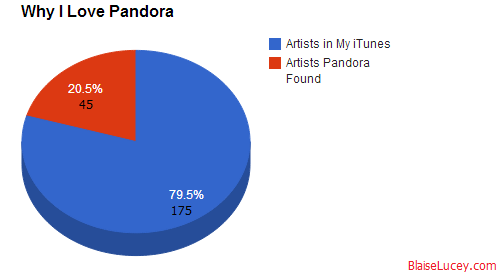
Aside from thousands of hours of entertainment, let me break down just how many bands in my iTunes are bands I never would have found without Pandora’s help:
Artists need to overcome the public’s fear of the unknown
People hesitate to buy something online from a barely-known band for the same reason you’re impatient while you read this: you’re not sure it’s going to be worth your time.
I bought albums from all of these bands, but not before finding and hearing the songs over and over again on Pandora, then previewing a few more on YouTube.
The irony? I could listen to all the songs on YouTube, forever, and call it a day and never support the artist in any way, shape, or form (yeah, Pandora gives royalties to streamed artists, but YouTube is a different matter).
Again, I became passionate about the bands, because I’m free to preview the material.
The same internet that risks giving away all of the bands’ stuff for free is also connecting me with all of these obscure artists in the first place. I want to support them, so I make that optional purchase.
The writer’s problem
I self-published a short story collection, “Technology and Culture Stink!” earlier this week.
It’s $2.99, which works out to about 17 cents a story.
Oh, you’re not going to buy it? Even though you enjoyed reading this blog post?
I don’t blame you.
Reading a book is an investment. In terms of our media consumption, books are in trouble: the rate of production is slow and the rate of consumption is slow.
Computers have spurred incredible growth in the number of songs people consume, but they sure didn’t do anything for books.
Reading an unknown author’s self-published eBook is almost unthinkable.
My hope is that, by writing enough blog posts, people will start to trust my writing enough to indulge me with that two dollars and ninety nine cents (or download it for free during one of the promotions), but I’m not sure it’s going to work, given how many books the average American reads.
The breakdown
1. Creative work is available for free, everywhere, on the internet.
2. Our capacity to consume is exponential because of the internet.
3. The democratization of publication has hurt the credibility of authors and musicians when it comes to getting compensated: people don’t trust that it will be good. If it is, it better be really good or they won’t pay for it.
4. My book of short stories is here, if you want to take a closer look at it. You could also read a free short story of mine that’s on the internet, to see what the material is like.
 blaiselucey.com
Leave a reply to Rebecca Green Gasper Cancel reply